 MY BOWLING JOURNEY
The Oil You Can't See Is Why Your 7pm Shot Stopped Working at 8:30
By Ryan · · Lanes · 5 min read
At some point every bowler has the same experience. You find the perfect shot in game 1. Same spot, same target, strike after strike. You start to wonder if you should quit your job and join the pro tour.
Then, somewhere in game 2, the exact same shot goes high and leaves a split that looks like a pair of goalposts.
You didn't change. The lane did. And the reason is something you can't even see: oil.
Wait, they put oil on the lanes?
Yes. Before league, a machine rolls down every lane and lays down a thin layer of oil. It protects the lane surface, and it also shapes how your ball moves.
Here's the simple rule. Where there's oil, your ball slides. Where there's no oil, your ball grips and starts to hook.
So the oil isn't spread evenly. It's laid down in a pattern, and that pattern decides how hard or easy the night is going to be.
The house shot: bowling with bumpers for grown-ups
Most league nights are bowled on a house shot. A house shot puts a lot of oil in the middle of the lane and much less on the outside.
That's a gift. If you miss a little to the inside, the extra oil keeps your ball from hooking too much. If you miss a little to the outside, the dry part grabs your ball and pulls it back toward the pocket.
That's why league averages can look so good. Most of us are getting a little help from the oil and taking full credit for it. I include myself. I take full credit every time.
Sport patterns: the oil stops being nice
In the summer I bowl sport patterns, which are flatter oil patterns with a lot less help built in. A miss stays a miss. They are humbling in a way a house shot never is.
Patterns are measured by how far down the lane the oil goes. A lane is 60 feet from the foul line to the head pin. On a long pattern, the oil goes far down the lane, so your ball slides a long way and hooks less. On a short pattern, the oil stops early and your ball has a lot of dry lane to hook on.
One summer night I bowled the stepladder finals for my league on a 55-foot pattern on one lane and a 28-foot pattern on the other. Same night. Same bowler. Two completely different jobs. It's like being asked to parallel park and do a drag race at the same time.
Why the lanes change during the night
Every time a ball rolls down the lane, it moves some of the oil. Some of it gets pushed farther down the lane. Some of it gets soaked up by the ball. After two hours of a whole league throwing on the same lanes, the oil in the main path is mostly gone.
Bowlers call this transition, or the lanes breaking down. Less oil in your path means your ball grips sooner and hooks more. So the shot that went perfectly into the pocket at 7:00 is now hooking too early and crossing over to the wrong side of the head pin at 8:30.
This happens faster when more bowlers are on the pair, and even faster when everyone is playing the same part of the lane. It also happens differently when you prebowl, since you don't always get fresh oil on those lanes.
So what do you do about it?
You move. For a right-handed bowler, when the ball starts hooking too much, the usual answer is to move your feet and your target to the left. That puts your ball in a part of the lane that still has some oil.
A common starting point is to move your feet two boards and your target one board, in the same direction. Then see what happens. If that wasn't enough, do it again.
Lefties do the same thing to the right. Lefties also tend to have their side of the lane less beaten up, which is something right-handers will complain about to anyone who will listen.
The other answer is to change balls. A ball with less grip, like a pearl, can slide through the drier part of the lane and save its turn for the end. We covered that in the last post, and my bag will cover it again every week whether you want it to or not.
The worst answer is the one we all try first: keep throwing the same shot and hope the lanes change back. They won't. I've tested this many times.
The Lane Blamer was a little bit right
In the first post I teased the guy who blames the oil for every bad shot. To be fair to him, the oil really is changing. His mistake is blaming it instead of moving.
The good news is that you can learn your lanes. Over a season, you start to notice patterns. Which pair breaks down fast. Which lane plays tighter. How many frames into game 2 you usually need to move.
The bad news is that you won't remember any of it next week unless you write it down. I know because I tried.
Seeing the oil without seeing the oil
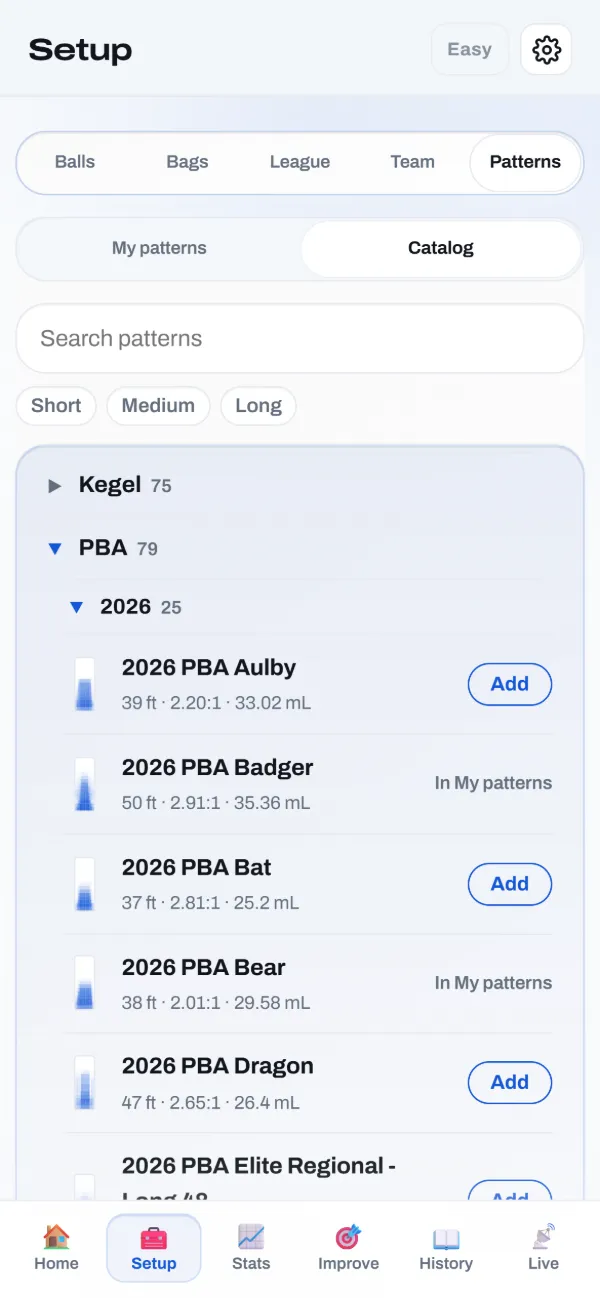
My Bowling Journey has a library of real oil patterns from Kegel and the PBA, drawn from their pattern sheets, and you can add the ones you bowl on to your own list.
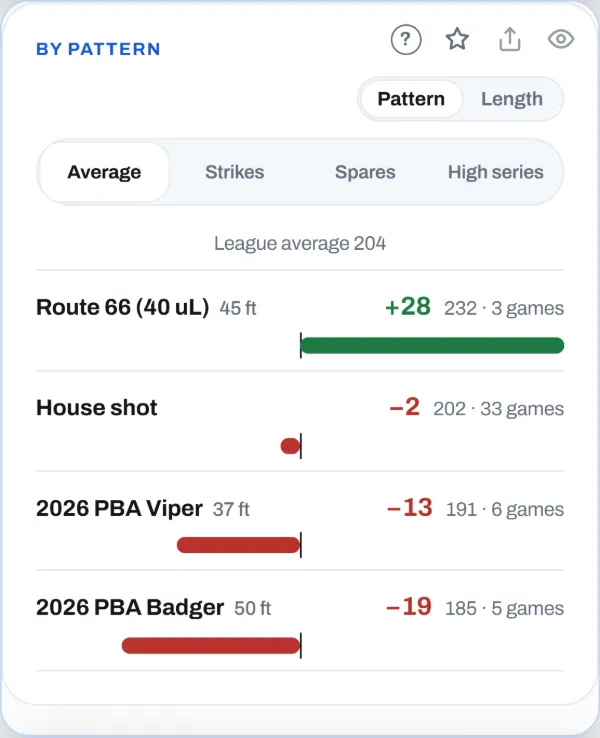
Once you've bowled on a few, By pattern shows your average, strikes, spares and high series on each oil pattern, and your average against your league average. It's a very honest card. It will tell you exactly which patterns you'd rather never see again.
And for the 7:00 versus 8:30 problem, Night Shift shows each ball's strike % fresh, in transition and late in the night. That's the "when should I have moved" question with an actual answer.
The bottom line
Oil is the reason bowling is harder than it looks. Your ball slides on it, hooks where it's gone, and the lane changes every time someone throws a shot.
So when your perfect shot stops working, don't take it personally. Take two boards left.
Or as I've said to myself more times than I'd like to admit: should've moved left.
Learn how your lanes change with My Bowling Journey. Free on Google Play.